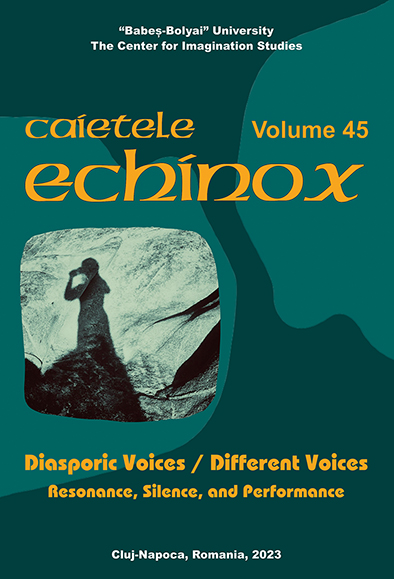
Diasporic Voices / Different Voices : Resonance, Silence, and Performance
Editors:
Laura T. Ilea
Mohamed Baya
Isabelle Galichon
Editeur :
Phantasma
Centre de Recherches sur l’Imaginaire
Université Babeș-Bolyai, Cluj-Napoca, Roumanie
caieteleechinox.lett.ubbcluj.ro
ISSN 1582-960X
DOI : 10.24193/cechinox.2023.45
458 pages, 24 Euros
Pour commandes s’adresser à :
Megaprint (Roumanie)
http://www.edituramega.ro/domeniu.php?domeniu=20
Contents
I. Diasporic Traditions, Transgressions, and Identities
Carmen Borbély, “Whence, Then, Is This Change of Sentiment?”: Homesteading and Restorative Nostalgia in The Woman of Colour
Gabriel Gherasim, Diasporic Transgressions of Commedia dell’arte
Maria Chiorean, A Geocritical Reading of Diasporic Identity in the Prose of Leila Aboulela, Jhumpa Lahiri and Monica Ali
Dragoș Bucur, Ghettos, Shettls and Projective Spaces. Diasporic Discourses in Jewish-Romanian Interwar Literature
II. Counterfactual Histories and Trans-Border Texts
Laura T. Ilea, Counterfactual Histories: Philip Roth and Nicole Krauss
Mohamed Baya, The Muslim Diaspora Giggles Back: A Touch of Humour in Notre-Dame and the Vatican’s Shadow
Raluca Moldovan, Counterfactual History and Diasporic Identity in Philip Roth’s The Plot against America
Constantin Tonu, Slavophile Elements in Andreï Makine’s Prose
Maria Barbu, Voices of the “In-Between”. Anarchetypal Crossings of the Frontier in Cormac McCarthy’s Border Trilogy
III. Mapping Diaspora: Politics, Memorials, and Praxis
Horea Poenar, The Curious Case of the Invention of Diasporic Identity. A Story of Jazz, Politics, Africa and Revolution
Andrada Yunusoğlu, Longing and Belonging in If They Come for Us by Fatimah Asghar and Home Is Not a Country by Safia Elhillo
Lavinia Tache, Embodiments and Voices of Inseparable Identities in The Book of My Lives and The Lazarus Project by Aleksandar Hemon
Georgiana Tudor, Diasporic Voices in The Messiah of Stockholm by Cynthia Ozick
Raluca Panait, The Western Reception of Forugh Farroghzad. New Orientalism and Confessional Poetry
IV. Diasporic and Interstitial Spaces
Loubna Achheb, Drame diasporique faussé et voix brisées dans l’écriture mokeddemienne
Ioana-Maria Marcu, Silence(s) des patriarches : configurations et valeurs de la « parole retranchée » dans la littérature des descendants de harkis
Nezha Ait-Aïssa, L’interartialité, une forme de l’écriture diasporique dans L’éloge de la perte de Lynda-Nawel Tebbani
V. Romanian Exile and Imagined Homelands
Ruxandra Cesereanu, Andrei Codrescu – A Portrait of a Writer in Puzzle
Gabriela Glăvan, Reimagining Centrality in Cătălin Dorian Florescu’s Short Stories
Edoardo Giorgi, Du sexe de la femme de Matei Vișniec : l’histoire d’un carnage incarné racontée à travers une superposition de voix
Catrinel Popa, Voicing the Unspeakable in Alexandru Vona’s Fiction
VI. Different Voices
Corin Braga, Littérature et théorie du chaos
Radu Toderici, “Romans Divers”: The Novel, Its Earliest Classifications, and the Early Modern Peripheries of the Genre
Simon Harel, L’écriture de l’alité. Dépathologiser la dépression dans Désormais ma demeure de Nicholas Dawson
María de los Ángeles Hernández Gómez, Pour une éthique de la parole dans la « littérature-refuge » : l’écriture impliquée de Marie Cosnay
Iulia Ursa, Voice Modulation Through Imaginative Exercises
Anda Ionaș, The Author’s Voice in Genre Films. Miracle and Unidentified by Bogdan George Apetri
Library Survey
Book Reviews